


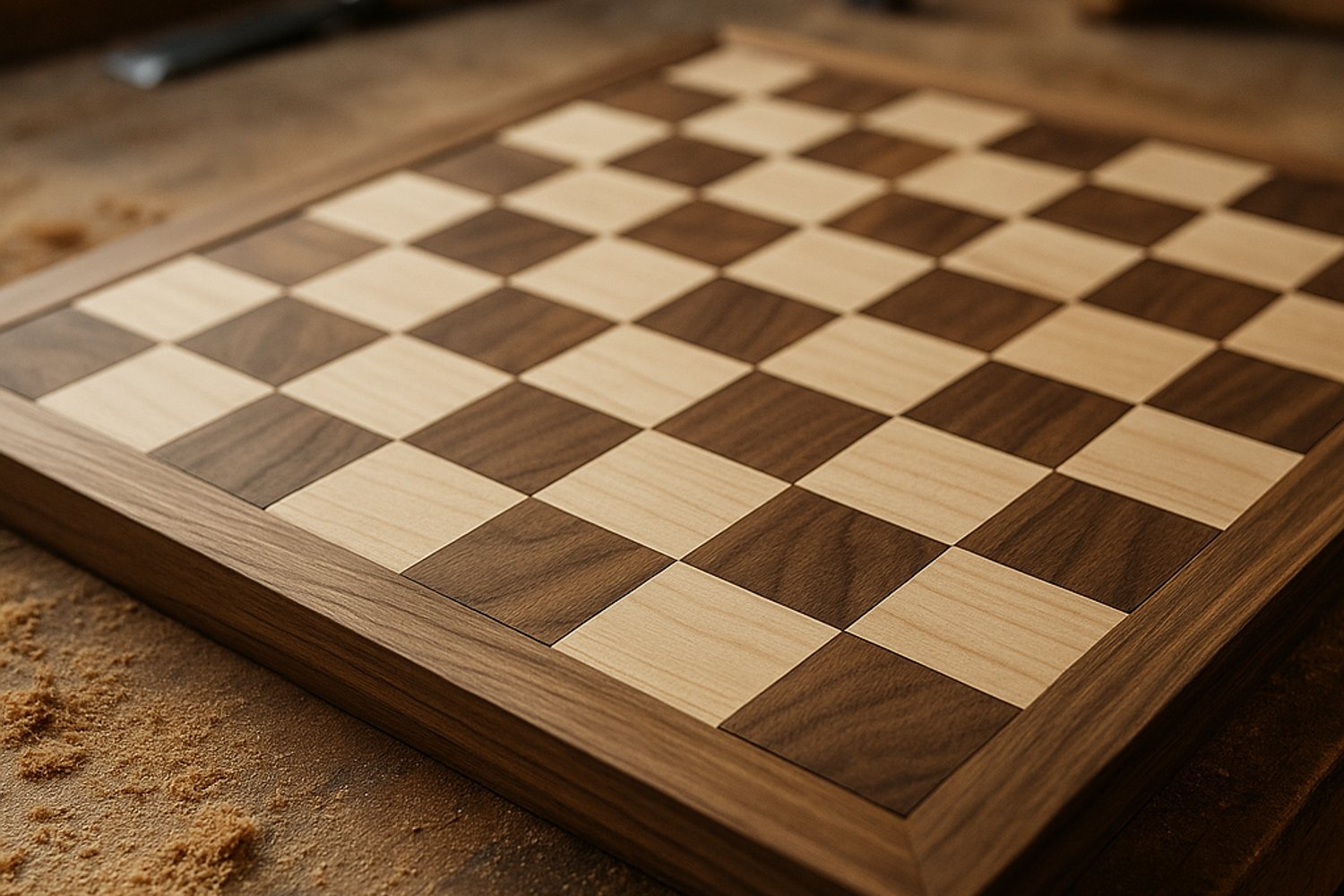
Chessboard Grain Orientation: How Wood Direction Shapes Play
Why the grain on a chessboard deserves a closer look
At first glance, a hardwood chessboard is just 64 alternating squares. But step closer and you’ll see the real story: grain lines running north-south on one square, east-west on the next; borders that either calm or compete with the pattern; a surface that feels steady under a sliding rook. Grain orientation is quiet work, and it has a big impact on how a game board looks, moves, and lasts.
In the shop, our makers at Old Line Woodcraft think about grain direction long before glue ever meets wood. This week, we’re opening the notebook on how grain orientation guides our layout for chessboards—and how similar choices play into cribbage boards too.
What “chessboard grain orientation” really means
Every wood square has a grain direction: the path of the tree’s growth lines. Most chessboards use face-grain surfaces for the playing squares (not end grain), because face grain provides a smooth feel for pieces and a visually readable pattern from across the table. On a checkerboard, the grain of each square may run the same direction or intentionally alternate between rows and columns.
Beyond the squares, the border frame has its own grain direction. Its job isn’t just to look clean—it also helps keep the field of squares flat over the seasons. Get the relationship between the field and the frame right and the board stays calmer through humidity swings.
Why grain direction matters to stability and look
Wood moves across the grain with seasonal humidity. On a chessboard, that motion can show up as a slight cup across the surface or hairline shifts at glue joints. Good grain planning helps keep those effects subtle and uniform.
- Stability: When laying out the initial laminated strips (often maple and walnut), alternating the growth ring orientation of adjacent strips helps balance internal forces. After crosscutting into square sets and flipping to create the checker pattern, that balance carries through the field.
- Visual flow: Consistent grain direction within each color (for example, most of the pale cream maple squares running one way) reduces visual noise. A few intentional reversals add character, but too many make the pattern feel restless.
- Surface feel: With grain running predictably, finishing and hand-sanding leave a smooth, even surface so chess pieces glide without catching.
Classic species pairings—and how their grain behaves
Certain species pair well not just for contrast but for how their grain reads when cut into small squares:
- Maple + Walnut: A timeless pair. Expect pale cream maple with a subtle, closed grain beside rich brown walnut with deep, natural grain movement. Maple brings clarity to the light squares; walnut provides warmth and visual depth.
- Maple + Cherry: Maple’s light tone contrasts with cherry’s warm, reddish-brown and smooth, even grain. Cherry gently deepens in tone with time, which can add a pleasing aged balance to the board’s overall look.
- Accent lines (subtle): Thin inlays or perimeter accents in naturally vivid purpleheart or orange-red padauk can frame the field without stealing the show. Used sparingly, they add a refined, game-night presence.
Whichever pair you choose, aim for boards where the maker selected stock with similar grain character within each color. Mixing one flatsawn piece with another that’s heavily figured can cause the squares to read unevenly.
Square layout: the quiet geometry behind the pattern
Most hardwood chessboards start as two long, laminated panels—light/dark/light/dark—glued with careful alignment. From there, the maker crosscuts the panel into identical strips of light–dark pairs, rotates every other strip, and reassembles the classic checkerboard. Inside this workflow, grain orientation choices pile up:
- Balanced glue-up: Alternating the growth ring orientation of neighboring strips (arched rings up, then down) helps the final board resist cupping.
- Grain direction within colors: Keeping maple strips all running lengthwise before the crosscut leads to a field where most light squares share a common grain direction, which reads calm to the eye.
- Square size vs. figure: Smaller squares can make wavy or curly grain feel busy. Slightly larger squares showcase natural movement without making the board hard to read during play.
Borders matter too. A border frame with grain that runs parallel on opposite sides and meets cleanly at mitered corners helps the eye rest after the alternating field. When possible, choosing border stock with straighter grain (often from more quartersawn-leaning boards) adds a quiet, linear counterpoint to the checker pattern.
Cribbage boards: grain direction and clean holes
Cribbage boards don’t have alternating squares, but grain direction still plays a big role. Peg holes prefer a steady, even surface with minimal tear-out:
- Straighter grain species: Maple or cherry with even, closed grain tends to drill cleanly and produce crisp pegged scoring lanes.
- Hole alignment with grain: Running tracks with the grain helps keep edges tidy and reduces the chance of small chip-outs between holes.
- Frame or edge treatment: Borders with slightly contrasting grain provide a finished look and support the panel against seasonal movement.
As with chessboards, a uniform protective clear finish on all faces helps manage moisture changes from season to season.
How to read grain quality on a finished game board
You don’t need a moisture meter to spot thoughtful grain planning. A few cues tell you a lot about a board’s long-term behavior:
- Consistent grain flow within colors: Light squares (maple) should mostly read in one direction; the same goes for dark squares (walnut or cherry). A little variation is natural—wild swings aren’t.
- Balanced checker field: Look for even joints with no noticeable steps between squares. That suggests well-matched thickness and careful sanding with the grain.
- Calm, supportive border: Borders with straighter grain that frames, rather than competes with, the field. Miters should close cleanly with continuous grain wrapping the corner.
- Flatness and finish on both sides: A board that’s finished top and bottom is less likely to cup. Slight seasonal movement is normal; a good layout minimizes it.
- Sensible accents: Thin, contrasting inlays in purpleheart or padauk can add definition. They should be tight, straight, and subordinate to the playing surface.
- Surface feel: A smooth, hand-sanded surface with a subtle satin sheen supports easy piece movement and shows the grain without gloss glare.
Care tips to keep grain behaving
Even the best grain plan appreciates a little help from you:
- Keep it flat: Store your chess or cribbage board on a level surface. Avoid leaning it long-term where gravity can encourage a twist.
- Moderate environment: Aim for steady, indoor humidity. Rapid swings can telegraph across the grain and show up at glue joints.
- Finish maintenance: If the sheen dulls after years of play, a light scuff-sand with a fine grit and a wiped-on coat of a compatible protective clear finish can refresh the surface. Test in an inconspicuous spot first.
- Sunlight awareness: Direct, prolonged sun can shift tones over time—warm cherry deepens, purpleheart can change in brightness—so display where light is friendly, not harsh.
A quiet craft that shows up in every game
Grain orientation rarely grabs attention on day one—but it pays out over years of moves and matches. A board that lies flat, reads clearly, and feels good under hand is usually the product of careful lumber selection and thoughtful layout. That’s the kind of quiet woodworking we enjoy most in the shop.
If topics like grain direction and layout spark your interest, keep stopping by Shop Talk for more behind-the-scenes notes from the bench. Come back next week for more.