


Jigs and Techniques for Assembling N-Sided Bowls
The Challenge of Compound-Angle Assembly
Building n-sided bowls and boxes with sloped walls presents a unique challenge: the panels meet at angles other than 90 degrees. Standard woodworking clamps want to push things square, but your joints are anything but. This guide covers the jigs and techniques that make assembly straightforward and repeatable.
Understanding the Dihedral Angle
Before building any jig, you need to know your dihedral angle—the internal angle where two adjacent panels meet when assembled. Our Compound Angle Calculator provides this value automatically. This angle is the foundation for every jig you will build.
For example, a 6-sided bowl with 75° wall slope has a dihedral angle of approximately 143°. This means when you glue two panels together, the inside corner forms a 143° angle, not 90°.
Method 1: Band Clamps
Best for: Quick assembly of regular polygons (all sides equal length)
Band clamps (also called strap clamps or web clamps) wrap around the entire perimeter of your assembly and apply even inward pressure on all joints simultaneously. This is the simplest approach for hexagons, octagons, and other regular shapes.
How to Use Band Clamps Effectively
- Dry fit first: Assemble all panels without glue to verify they close properly. Number each panel and mark the orientation.
- Apply glue to all joints: Work efficiently—you are racing the glue open time. Apply a thin, even layer to both mating surfaces of each joint.
- Position the band: Wrap the band around the middle of the assembly. For tall pieces, use two bands—one near the top and one near the bottom.
- Tighten gradually: Cinch the band slowly while guiding the panels into position. Watch for any joints that want to slide past each other.
- Check for square: Even though the walls lean, the top rim should form a flat plane. Use a straightedge across the top to verify.
Method 2: Angle Blocks (Wedge Blocks)
Best for: Precise control, odd-shaped assemblies, or when you need serious clamping pressure
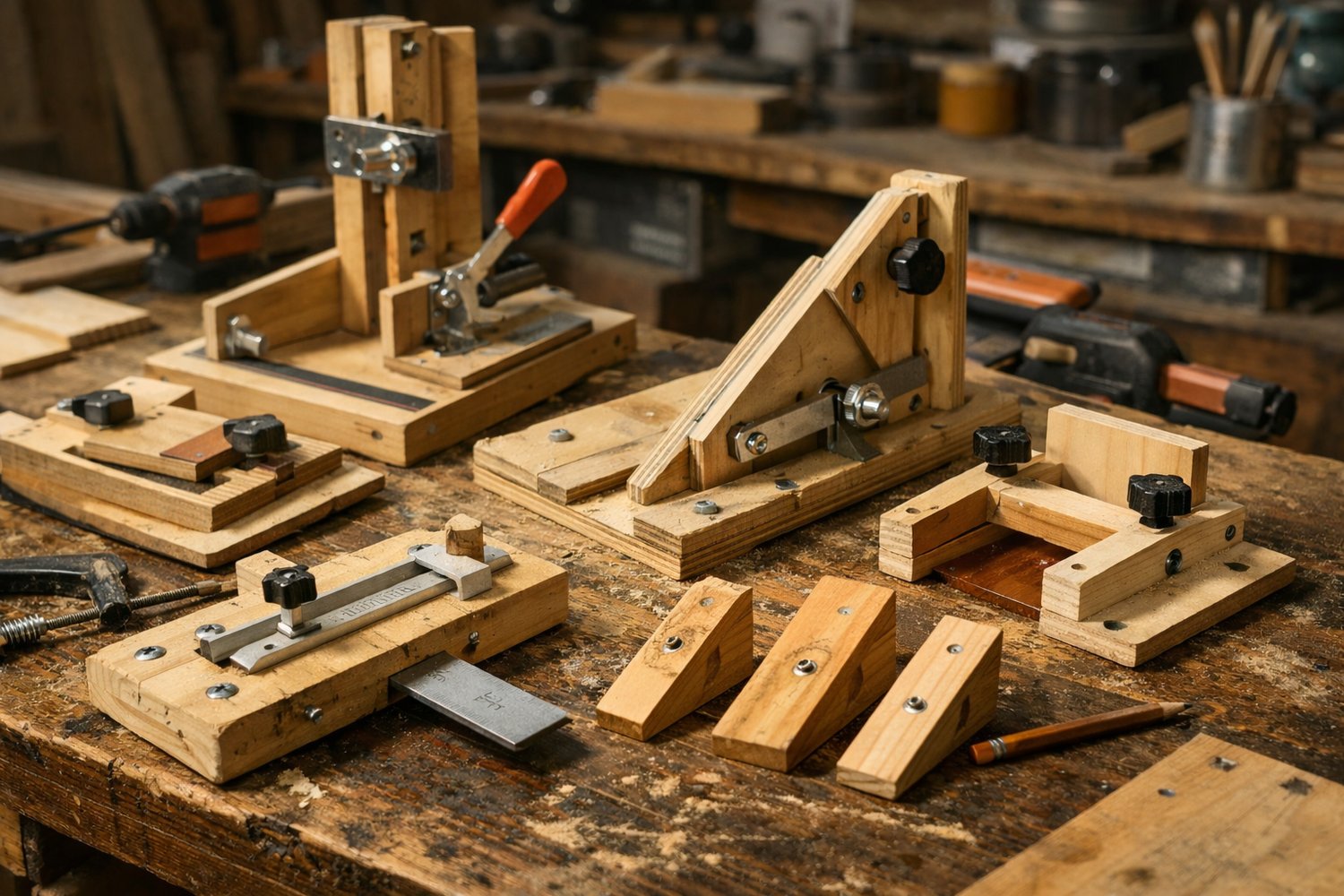
Angle blocks convert your non-90° surface into a flat clamping surface. When placed against the sloped panel faces, they let you use regular bar clamps or pipe clamps to apply pressure.
Building Angle Blocks
The critical measurement is half the exterior angle (which equals 180° minus the dihedral angle, divided by 2). For our 6-sided example with a 143° dihedral angle:
- Exterior angle = 180° - 143° = 37°
- Block angle = 37° ÷ 2 = 18.5°
Cut blocks from stable hardwood or plywood at this angle. Make them long enough to span most of the panel height, and wide enough to provide a solid clamping surface (at least 2-3 inches).
Using Angle Blocks
- Tape blocks to panels: Use blue painters tape to temporarily attach blocks to the outside face of each panel, positioned so the flat face points outward.
- Assemble with bar clamps: Now you can use standard bar clamps to push the blocks toward each other, applying even pressure to the joints.
- Alternate clamp positions: Use opposing clamps to balance pressure—one from the left side of a joint, the next from the right side.
Method 3: Assembly Cradle
Best for: Repeated production of the same shape, or very precise alignment
An assembly cradle is a dedicated jig that supports your bowl at the exact angles needed during glue-up. Once built, it makes assembly nearly foolproof.
Building a Simple Cradle
- Cut a base board: Make it large enough to support your bowl with working room around it.
- Create V-blocks or angled supports: Cut blocks at angles that match the wall slope of your bowl. These support the panels from the outside while you clamp from above.
- Add a center post: A dowel or post in the center can help keep panels from sliding inward during clamping.
Step-by-Step Assembly Sequence
Regardless of which clamping method you use, this sequence produces the best results:
- Prepare your workspace: Clear a flat surface. Have all clamps ready and adjusted to approximate size. Keep clean rags and a damp cloth nearby for glue squeeze-out.
- Complete dry fit: Assemble everything without glue. Verify all joints close tightly. Mark each panel with its position (A-B-C-D-E-F for a hexagon).
- Glue in pairs: For larger assemblies, glue panels into pairs first. Let these cure, then join the pairs. This gives you more open time and smaller assemblies to manage.
- Apply glue: Use a brush or roller for even coverage. Too little glue creates weak joints; too much creates a mess and can cause hydraulic pressure that prevents joints from closing.
- Close the ring: With all joints glued, bring the assembly together into a ring shape before clamping.
- Clamp and verify: Apply your clamping method. Use an angle gauge to verify the dihedral angle at a few joints—it should match the calculator value within a degree or two.
- Clean squeeze-out: Wipe excess glue from inside corners while it is still wet. A damp cloth or a sharpened dowel works well for inside corners.
- Let cure completely: Follow your glue manufacturer recommendations for cure time before removing clamps.
Tips for Success
- Test your angles on scrap: Before committing to your good wood, glue up two scrap pieces at the same settings. Verify the dihedral angle with a protractor.
- Work in a warm shop: Most wood glues need temperatures above 50°F (10°C) for proper curing.
- Use slow-set glue: Extended open time gives you more working time. Titebond Extend or similar products provide 15-25 minutes of open time.
- Have a helper: For large assemblies, an extra pair of hands makes the difference between a calm glue-up and a panic.
Verifying Your Assembly
After assembly, verify your work:
- Check the dihedral angle: Use an angle gauge at each joint. All joints should be within 1-2° of the calculated value.
- Check the rim: Place a straightedge across the top. It should sit flat with no gaps or rocking.
- Check for twist: Set the bowl on a known-flat surface. All bottom edges should contact evenly.
With the right jigs and a systematic approach, compound-angle assembly becomes a predictable process rather than a stressful gamble. Build your jigs once, and you will use them for years of successful projects.