


What Is a Wood Glue-Up? Building Stable, Wide Panels
Behind the scenes of a reliable wide panel
Most wide, flat wood surfaces you see from small shops aren’t cut from a single giant slab. They’re built thoughtfully from narrower boards in a process woodworkers call a wood glue-up. If you’ve ever admired a striped cutting board or a smooth box lid with seamless joints, you’ve seen a glue-up doing its quiet, dependable work.
In our shop, glue-ups show up everywhere: in cutting and serving boards, in décor panels, and in the tops and lids used for boxes. Done right, a glue-up delivers strength, stability, and a surface that lets the natural grain carry the design.
What we mean by “wood glue-up”
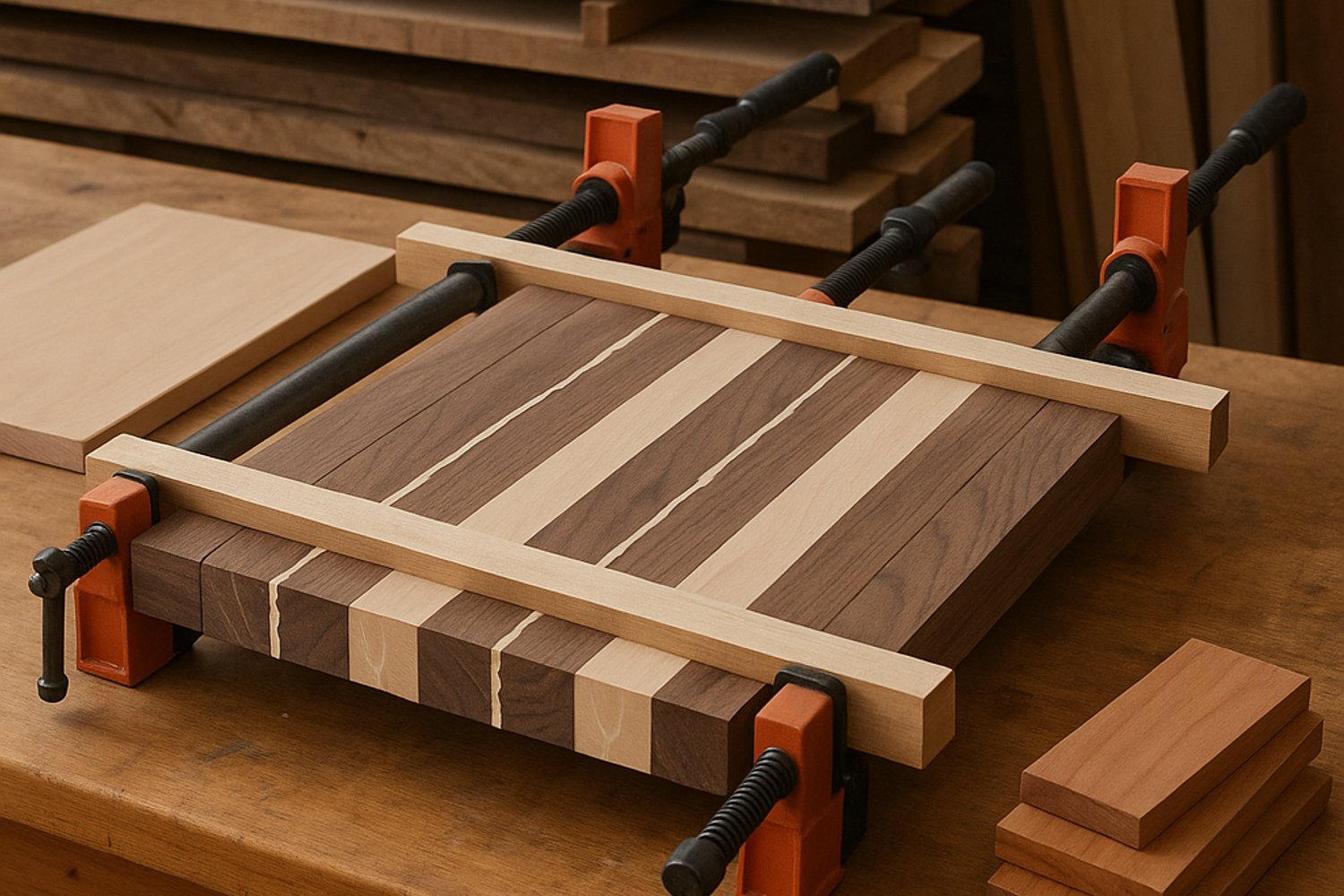
A glue-up is simply the edge-gluing of individual boards to create a wider, stable panel. Modern wood glues form bonds that are typically stronger than the surrounding wood fibers, so the joint isn’t the weak point. The work is in the prep: straight, square edges; a careful layout; even clamping pressure; and the patience to let the panel rest before surfacing.
When you hear phrases like panel glue-up, edge-glue, or laminated wood panel, they all point to the same family of techniques—joining boards so they move predictably through the seasons and present as one unified surface.
Why not just use one wide board?
There’s a romance to a single wide slab, but glue-ups solve real-world challenges:
- Wood movement: Solid wood expands and contracts across the grain as humidity changes. Narrower pieces glued edge to edge distribute and balance that movement, reducing seasonal cupping and distortion.
- Material efficiency: Narrow stock is more available and allows us to select the best parts of each board, minimizing waste while matching color and grain.
- Design control: A glue-up can highlight contrast (think rich brown walnut alongside pale cream maple) or keep things quiet and uniform with closely matched cherry or mahogany tones.
Laminated vs. multi-board panels—what’s the difference?
We often use two approaches, depending on the piece and how it will be used.
Laminated (narrow-strip) panels: Many cutting and serving boards are built from a series of narrow strips. This yields excellent stability and allows for purposeful patterning—subtle stripes in maple and cherry, or bolder accents using purpleheart, padauk, or canarywood. Narrow laminations also make it easier to orient grain carefully and keep the board flat through daily kitchen use.
Multi-board (fewer, wider) panels: For a décor panel or a box lid, we may join just two or three wider boards. This approach preserves broader, flowing grain while still gaining the stability of an edge-glued panel. Fewer seams keep the look calm and grain-forward—ideal when you want the natural character of walnut, cherry, or mahogany to take the lead.
Here’s a quick way to think about it:
- Choose laminated when durability under heavy use and pattern flexibility matter—like a daily-use prep or serving surface.
- Choose multi-board when you want a cleaner, uninterrupted look that lets wider grain movement show—like a smooth box top or a wall-ready décor panel.
Anatomy of a clean glue-up at Old Line Woodcraft
Every shop has its rhythm. Here’s how we approach a reliable wood glue-up in small batches:
- Acclimate the stock: Boards rest in the shop until they reach a steady moisture level. Stable wood makes stable panels.
- Thoughtful layout: We orient boards so grain direction and color play well together. Walnut’s deep brown pairs smoothly with cherry’s warm tone; maple brings light contrast; exotic accents like purpleheart or padauk introduce a deliberate, colorful line when the design calls for it.
- Straight, square edges: Clean mating edges are everything. Tight joints reduce glue lines to nearly invisible hairlines once surfaced.
- Dry fit: We clamp the panel without glue to confirm alignment and pressure points. Any surprises get solved here, not with the clock ticking.
- Even glue spread: A thin, continuous film along each edge ensures a full bond. Too little starves the joint; too much just makes cleanup harder.
- Controlled clamping: Clamps alternate above and below to keep pressure balanced. Cauls—straight guides along the face—help the panel cure flat.
- Rest and cure: After initial set, we remove squeeze-out and let the panel relax before surfacing. This minimizes post-glue tension and preserves flatness.
- Surface refinement: We flatten lightly, then hand-sand to a smooth, even surface, dialing in the final profile with softened edges or a subtle chamfer where it suits the piece.
Reading grain to reduce surprises
Grain direction matters during both the glue-up and the later surfacing. We look for reversing grain—places where the fibers shift direction—and stagger or rotate boards to keep those tricky areas from all landing in the same spot. On a box lid or décor panel, aligning the flow of the grain also reduces visual seams and keeps the eye moving naturally across the surface.
How finish fits in
Finish doesn’t hold a joint together—that’s the glue’s job—but it does complete the panel. Kitchen pieces are sealed with a food-safe oil-and-wax finish that’s easy to refresh at home. Décor and box panels typically receive a protective clear finish with a natural matte or subtle satin sheen, letting the grain of walnut, cherry, maple, hickory, or mahogany show through without plastic gloss.
Common questions we hear
Will I see the glue lines? In a careful panel glue-up, joints are tight and grain-matched. Under finish, most lines fade into the natural grain movement. High-contrast designs (like maple and walnut stripes, or a purpleheart accent) intentionally show each lamination as part of the pattern.
Are glue joints strong? Yes. A proper edge-glued joint is typically stronger than the boards themselves. If failure happens under extreme stress, wood fibers around the joint usually give way before the bond does.
Does species choice matter? Absolutely. Maple’s pale, closed grain reads crisp; walnut’s rich brown shows deeper movement; cherry warms to amber over time; hickory adds rugged contrast; mahogany settles into a balanced, warm tone. Exotic accents like purpleheart, padauk, or canarywood add distinct color lines when the design calls for contrast. The right pairing depends on whether you’re after subtle harmony or bold, graphic stripes.
What about seasonal changes? Even in a well-made glue-up, wood still moves slightly. We build with that in mind—balanced board orientation, proper acclimation, and finish choices that slow rapid moisture exchange. The result is a panel that stays true through normal humidity swings.
Why this matters in a small-batch shop
Glue-ups are one of those quiet, everyday craftsman moves that separate a quick build from a lasting one. In small batches, we can tune board selection and layout for each piece—color, figure, and grain direction—rather than forcing a one-size-fits-all pattern. It’s how a cutting board stays flat on your counter, how a box lid closes flush, and how a décor panel reads as a single, intentional surface.
If you’re curious how a wood glue-up could shape your next kitchen or décor piece, take a closer look at the grain choices in our work and the way panels are composed. Those seams—visible or not—are there by design.
Explore our shop, and come back next week for more behind-the-scenes woodworking insights.