


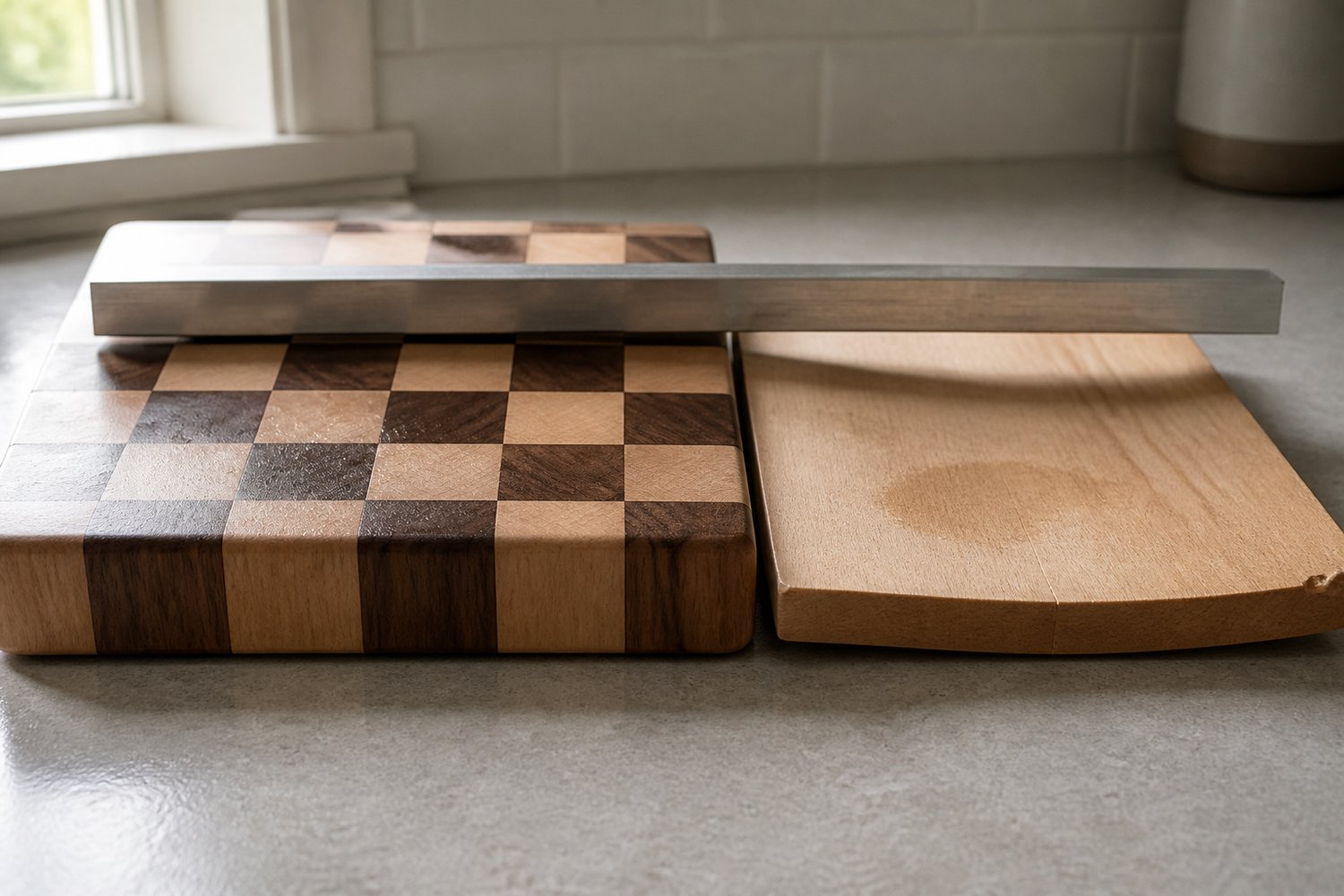
Why Handmade Cutting Boards Last Longer: Details Factories Skip
Some cutting boards age into trusted kitchen tools. Others cup, crack, or feel tired after a season. The difference isn’t luck—it’s build decisions. Here’s a clear look at why handmade cutting boards often last longer than factory-made boards, and how to spot the construction details that matter.
Grain orientation sets the foundation
Grain direction is the first clue to longevity. In broad strokes, you’ll see three approaches:
Edge-grain: Strips of hardwood glued side-by-side so the long grain faces up. This creates a stable, knife-friendly surface that’s well-suited to daily meal preparation. When done carefully, edge-grain boards balance durability with a lighter overall weight.
End-grain: Blocks arranged so the cut ends of the wood fibers face up. End grain is prized for a resilient cutting surface that is gentle on knife edges; the fibers can compress under the blade and recover. It’s a more complex glue-up and sanding process but pays off in toughness for heavy chopping.
Face-grain (plank) boards: The broad face of a board is used as the surface. It can look beautiful but is more prone to showing knife marks and seasonal movement, especially when made thin or from wide single planks. Many mass-market boards lean on face grain for speed of production, which can shorten their working life.
Handmade boards from small shops tend to favor well-executed edge-grain or true end-grain layouts. The aim is predictable movement, a flat cutting plane, and a surface that wears gracefully with use.
Hardwood species: density and grain matter
Species choice directly affects how a board feels under the knife and how it holds up. Domestic hardwoods like maple (pale cream with subtle, closed grain), walnut (rich brown with deep, natural grain movement), and cherry (warm, reddish-brown with smooth, even grain) are time-tested in kitchens. Hickory brings notable strength with a pronounced grain but extra weight.
Accent woods can add contrast. Purpleheart offers a naturally vivid purple tone with consistent, fine grain. Padauk shows orange-red base tones, while canarywood brings lively color variation. Leopardwood adds a distinctive flecked figure, and mahogany leans warm with a gentle grain. Used thoughtfully, these exotics can highlight pattern without compromising function.
Factory boards sometimes rely on softer woods, thin laminations, or low-density materials to cut cost and weight. That can feel good at unboxing, but dense closed-grain hardwoods tend to resist wear, staining, and moisture ingress better over time.
Glue lines: tight joinery and stable panels
A cutting board’s longevity often rides on the quality of its glue-up. Look for tight, uniform joints with no gaps or visible glue squeeze-out. Small-batch shops typically mill each strip flat and square, dry-fit patterns, and apply a food-safe, water-resistant adhesive before a careful clamping sequence.
Why it matters: everywhere two pieces meet is a potential failure point if the surfaces weren’t prepared cleanly or if clamping pressure was uneven. Precise milling and patient assembly keep panels stable through seasonal humidity shifts. You don’t always see this at first glance, but you’ll feel it months later in a board that still sits flat.
Thickness and proportion: built to stay flat
Heft helps. A thicker board better resists flexing and minor fluctuations in humidity. Balanced proportions—length, width, and thickness chosen for the board’s intended use—also reduce the chance of cupping. Handmade boards often include small but telling details like a gentle chamfered perimeter, softened radius corners, or integrated handholds that make a substantial board easier to move without sacrificing stability.
Mass-produced boards are frequently thinned to save material and freight cost. That can work for serving pieces, but for daily slicing and chopping, extra thickness and a flat, well-supported surface pay dividends.
Finishes you can renew
Long-lived boards wear a food-safe oil-and-wax finish. This approach soaks into the fibers, repels moisture, and is easy to refresh at home. When the surface looks dry, you clean, dry, and re-oil—it’s that simple.
By contrast, thick film finishes (like heavy varnish or sprayed lacquer) can look glossy out of the box but tend to chip under knife work and are hard to repair seamlessly. Once the film breaks, moisture can creep in. For a workhorse board, a breathable, oil-forward finish is the practical choice.
Design choices that respect daily use
Durability isn’t just about surviving stress—it’s about avoiding stress. Details that help:
- Gently eased edges to reduce denting and splinter risk.
- Clean, shallow juice grooves (when included) that don’t weaken the board’s core panel.
- Balanced grain direction on mirrored patterns so movement happens evenly across the width.
- Smooth, hand-sanded surfaces that accept oil uniformly and are comfortable in the hand.
These are the kinds of refinements small shops bake into their process. They’re not flashy, but they add up in day-to-day performance.
Care is half the equation
Even the best board needs basic care. The good news: it’s simple.
- Wash by hand with mild soap and warm water. Avoid soaking.
- Dry upright so air reaches both faces. Don’t lay it flat on a wet counter.
- Use both sides to encourage even wear and reduce cupping.
- Re-oil regularly—when the surface looks dry or water no longer beads. Wipe on oil, let it soak, then buff a thin wax if you like a satin feel.
- Refresh the surface with a light sanding if needed, then reapply oil-and-wax.
Follow those steps and a well-made board will work for years. Many handmade boards are intentionally finished so owners can maintain them without special tools—just a rag, a bit of oil, and a few minutes.
How to spot a well-built handmade board
When you’re comparing options in person or online, use this quick checklist:
- Species clarity: Look for durable hardwoods—maple, walnut, cherry, hickory—and, when present, exotics used thoughtfully as accents like purpleheart or padauk.
- Grain orientation: Edge-grain or end-grain surfaces for knife work; face-grain used intentionally for serving.
- Joinery quality: Glue lines are tight with consistent patterns and no gaps.
- Proportion and thickness: Feels substantial in hand, sits flat on the counter.
- Finish type: Food-safe oil-and-wax described clearly, not just “sealed.”
- Refined details: Softened edges, comfortable handholds, and a smooth, even surface.
Pieces shaped in small batches by Old Line Woodcraft artisans follow these principles: solid hardwood construction, precise panel glue-ups, and finishes designed for easy renewal. The result is a board that wears in, not out.
Repairability: a built-in advantage
Handmade boards are typically easier to bring back to like-new. If a surface gets tired, a quick round of sanding—often starting with a medium grit and moving to a fine grit—followed by a fresh coat of oil restores color and sheen. End-grain boards can be resurfaced carefully with sanding until the fibers stand clean again. The goal is to preserve the board’s flatness and keep the grain forward without removing unnecessary material.
Factory boards built with thin stock, brittle finishes, or weak glue joints don’t respond as well to these tune-ups. When film finishes chip or laminations fail, there’s not much material to work with.
In other words, longevity isn’t accidental. It’s engineered into the board during layout, species selection, glue-up, and finishing—and protected by simple, consistent care.
For those who cook daily, that combination is what turns a board into a trusted tool. And as wood develops a soft patina from use—walnut’s deep browns, maple’s pale cream, cherry’s warm shift—the board becomes part of the kitchen’s rhythm.
If you’d like to see how these choices show up in practice, explore our shop or browse our latest work. We keep the focus on honest materials, careful construction, and finishes that are easy to live with.