


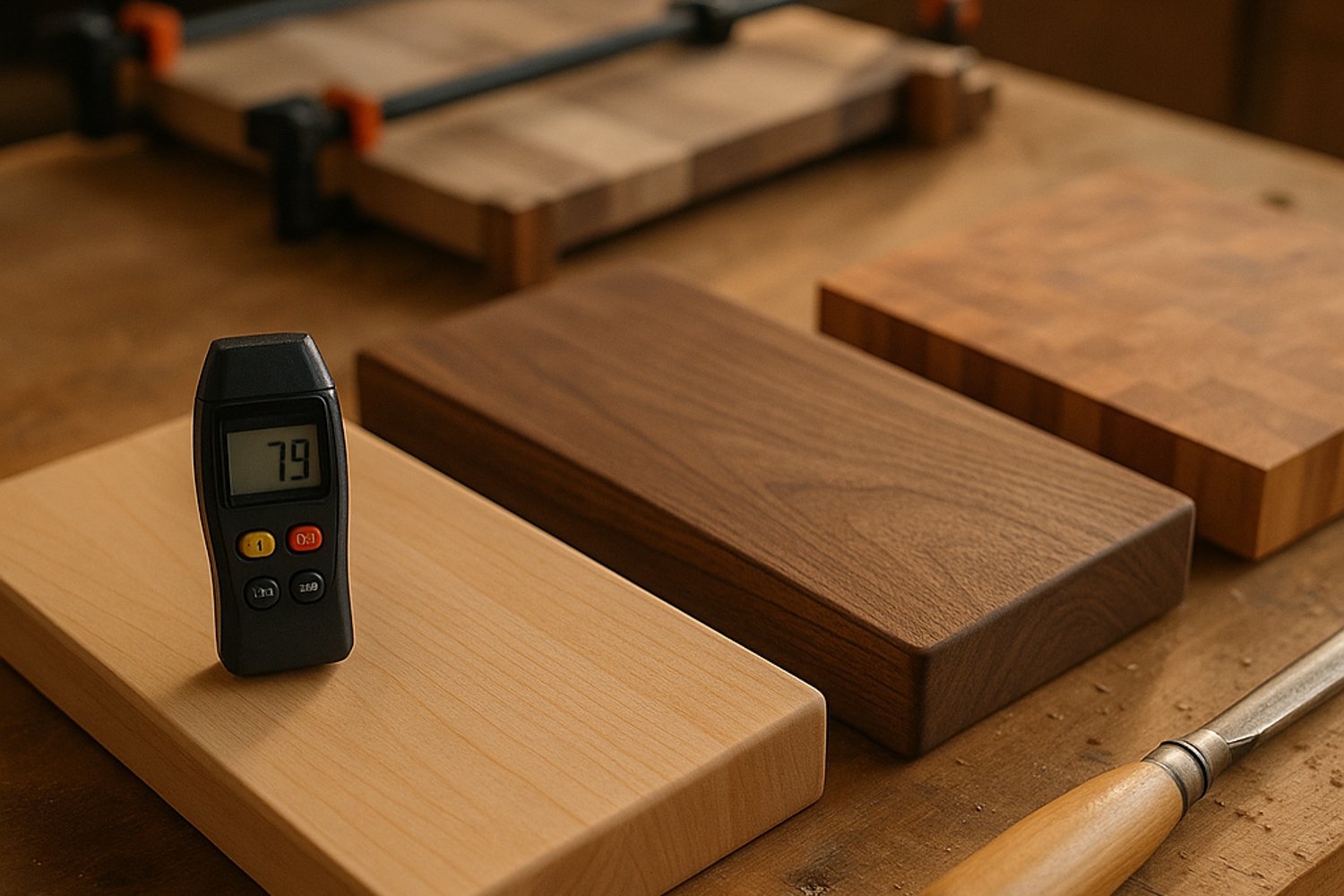
Wood Movement 101: How Seasonal Humidity Shapes Solid Wood
If a cutting board suddenly rocks on the counter in July but sits flat in January, you’ve met wood movement. Solid wood is alive to the seasons, and understanding that simple fact explains a lot—from why a board might cup after a big holiday cookathon to how we build stable panels here in the shop.
What wood movement really is
Wood takes on and gives off moisture until it matches the air around it. That balance point is called equilibrium moisture content. When indoor air is humid, wood swells; when it’s dry, wood shrinks. The change doesn’t happen evenly in all directions. Most movement happens across the grain, very little along the grain.
On a finished piece you’ll notice that as subtle cupping, a slight gap that wasn’t there last month, or a lid that feels just a touch tighter or looser. None of this means something is “wrong.” It’s simply how solid wood responds to seasonal humidity.
Why kitchens are hard on wood
Kitchens swing through steam, heat, and dry downdrafts. Boiling a big pot can nudge the room’s relative humidity up; running the oven and hood fan can dry it out fast. Those quick swings are prime drivers of short-term wood movement.
We see it most in boards that live full-time beside the sink or stove. One face gets splashes and the other doesn’t, so moisture changes unevenly. That imbalance shows up as a little cup. Good news: with even care and time back in a steady environment, most pieces settle again.
How we plan for movement in the shop
Keeping solid wood stable is as much about process as it is about design. Around here, the makers at Old Line Woodcraft do a few consistent things before a piece ever reaches your counter or shelf:
- Acclimation: We sticker-stack lumber in our shop until moisture readings are in a comfortable indoor range for our region.
- Thoughtful panel glue-ups: For cutting and serving boards, we laminate strips with similar grain and color for a stable, cohesive surface. Narrower laminations help distribute seasonal stress more evenly.
- Balanced construction details: Boxes use recessed bottom panels that have room to move within their grooves, and lids are fit with a little seasonal give so they open smoothly year-round.
- Even finishing: We apply a food-safe oil-and-wax finish to kitchen boards and a protective clear finish on décor and boxes. Finishing both faces helps slow moisture exchange to a more predictable pace.
Edge-grain vs. end-grain boards and movement
Grain orientation shapes how you’ll see wood movement in daily use:
- Edge-grain boards (strips laminated with long grain on the face) may show slight width changes with the seasons and are more prone to a gentle cup if one side gets much wetter than the other. They’re reliable for daily prep and lighter in hand.
- End-grain boards (with growth rings facing up) tend to stay flatter because most seasonal change happens through the board’s thickness, not across its face. They’re heavier and kind to knife edges, making them popular for frequent chopping.
Both styles serve well when built from stable stock and maintained evenly. In our batches, we commonly work with maple’s pale cream tone, rich brown walnut, warm cherry, and lively accent species like purpleheart or padauk for contrast—each bringing a distinctive grain look to the surface.
Panel construction for stable pieces
A good panel glue-up is about predictability. We match boards for grain direction and visual continuity, keep laminations consistent in thickness, and clamp with even pressure so the surface cures flat. That attention to a laminated surface is what helps a wide cutting board or wall piece remain calm as indoor air changes over the months.
For small boxes and décor, parts are sized and assembled to allow subtle shifts. A recessed bottom panel can move within its groove without stressing a corner. Tight, crisp mitered corners stay crisp because the panel isn’t trying to push the sides apart.
Simple home habits that minimize movement
You don’t need a woodshop to keep wood happy. A few steady habits go a long way:
- Keep humidity in a comfortable range. If you can, aim for roughly 35–50% relative humidity indoors. Consistency is more important than a specific number.
- Let both faces breathe. Store boards flat on small feet or a rack so air reaches both sides. Avoid leaving a wet face down on a countertop.
- Even out moisture after washing. Rinse, wipe dry, then stand the board on edge to air out both faces. Avoid soaking and never use a dishwasher.
- Refresh the finish periodically. For kitchen boards, a light coat of food-safe oil or oil-and-wax on a clean, dry surface slows moisture swings and keeps the grain sealed.
- Avoid direct blasts. Don’t park boards against a heat vent, under strong sunlight, or inches from the stove burner.
What cupping really means (and what to do)
A slight cup usually points to uneven moisture—one face taking on or giving off water faster than the other. Give the board an even dry-out after washing, then let it rest flat with airflow on both faces. Many times the board eases back within a day or two.
If knife marks or raised grain become noticeable, a light re-sand followed by an oil-and-wax finish levels things out. Keep the sanding even across both faces so each side exchanges moisture at a similar rate.
Seasonal expectations, not surprises
We build with seasonal change in mind, and we measure before we glue. That’s why panels lie flat, box lids fit with a clean glide, and décor pieces don’t telegraph stress at their corners. Still, solid wood will always live a little with the weather—it’s part of its appeal. The gentle shift in a maple board’s surface or the way walnut’s grain catches light in winter’s low sun are reminders that you’re using a natural material, not a static sheet.
Species notes, the visual way
While movement is primarily about environment and orientation, the look is where species speak most clearly:
- Maple: pale cream with a subtle, closed grain—clean and bright on a prep board.
- Walnut: rich deep brown with natural grain movement—handsome in a larger serving surface.
- Cherry: warm reddish-brown tones that deepen with light, showing smooth, even grain.
- Purpleheart and padauk: bold accent colors that add graphic contrast in laminated boards.
- Leopardwood and canarywood: distinctive patterning and color play that make smaller décor and box panels stand out.
- Hickory and mahogany: character-forward grain that reads strong and grounded in functional pieces.
Whatever the species mix, the goal is the same: a stable, grain-forward surface built for daily use.
Bringing it back to the bench
At the end of the day, wood movement isn’t a problem to be eliminated—it’s a behavior to be respected. With balanced construction, even finishing, and a bit of care at home, solid-wood pieces stay steady through the seasons. That’s the quiet craft behind every laminated cutting board, shaped box, or grain-forward décor item we send out from Old Line Woodcraft.
Have a question about wood movement in a piece you own? Explore our shop, browse our latest work, and come back next week for more shop notes.